Laundry Centers
A Frigidaire laundry center packs a washer and a dryer into one tall cabinet. Here is what the lineup looks like, where…

Specialized Frigidaire Appliance Repair in San Francisco
Mon–Sat: 8:00 AM – 7:00 PM
One cabinet, two machines, and a fault that can hide in either half. We separate them before suggesting a repair.
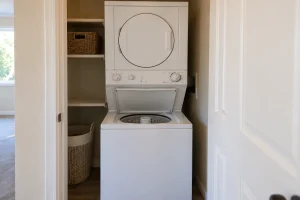
A laundry center puts a washer and a dryer in one tall cabinet, which is why it appears so often in San Francisco apartments, in-law units and hallway closets where a side-by-side pair would never fit. It also means a problem in one half can look like a problem in the other. Our Frigidaire laundry center repair work is built around that shared design: one cabinet, one power cord in most installations, and two very different jobs happening inside it.
The first question is always which half is failing, or whether both are.
In a stand-alone washer or dryer the technician can isolate one machine. In a laundry center the two sections share a frame, often a wiring harness and sometimes a control. A fault that seems to be in the dryer may begin with a connection that also feeds the washer. Our technician therefore tests each half separately, then looks at what they share before suggesting a repair.
That approach avoids the situation where a part is replaced and the symptom stays. You still get a written estimate that names the faulty component, and nothing proceeds until you say yes.
Most calls in the Bay Area involve one of these arrangements, and each affects how we work.
Closet installs. Many units live in a closet with a louvered or bi-fold door. A narrow gap means limited access to the rear, and the technician may need to slide the unit forward. Clear the space ahead of time and tell us about steps, hallways or elevators between the parking spot and the unit.
Water lines and drain standpipe. The washer needs two supply valves and a standpipe or utility sink drain. A standpipe that is too low can siphon, one that is too tight can back up, and a kinked hose looks exactly like a failing drain pump. We check the plumbing side before opening the cabinet.
Dryer venting. Stacked units frequently exhaust through a wall at the back of a closet and sometimes through a long run to an exterior wall. Bends and crushed foil duct restrict airflow, so a dryer that shuts off early may need a clear vent rather than a part.
Electric and fuel type. Laundry centers here are electric. Check the dedicated outlet and the breaker before you call, and tell us if the outlet is shared with other equipment.
Leave panels in place. Do not run the unit with the cabinet open, test wiring, or force a stuck door.
Unplug the unit or switch the breaker off if you see water pooling, smell something burning, or the cabinet is hot to the touch. Burning smell or sparks mean power off at the breaker right away. If a leak is reaching a neighbor’s ceiling, close the water supply valves behind the unit first. Wet floors and wiring are a poor combination, and every extra cycle makes the cleanup bigger.
Laundry centers differ in cabinet size, controls and the way the washer and dryer are joined, so replacement parts are not interchangeable. The label is usually on the door frame of the washer or inside the dryer door. We cover the GCET1031FS, a Gallery electric laundry center that is now discontinued, and the FLCE7522AW, an electric laundry center listed with a 3.9 cu ft washer and a 5.5 cu ft dryer. Send the number with your request so the technician can plan the visit.
You submit the request with the symptoms, the model number and notes about access. The technician arrives, hears the history, tests the washer half and the dryer half and reports what was found. A written estimate follows with the part and the labor, you choose whether to go ahead, and the repair is done only after your approval. If a part must be ordered, we tell you which half is safe to use and which should stay off in the meantime.
If the washer half is the main concern, read our washer repair and dryer repair pages for the details on each machine. The Frigidaire laundry centers guide covers the lineup and where to find the label. For drainage trouble, the washer will not drain article lists what to check.
Not always. Many dryer repairs are done with the cabinet in place, though some require pulling the unit forward. We tell you before work begins.
Yes. A power or wiring fault, or a shared control, can affect both sections, which is why the technician tests each half and the shared parts separately.
Usually not. Clear the floor in front, tell us about stairs or elevators, and mention any tight turns so the technician can bring the right tools.
The tall cabinet magnifies any imbalance. Level feet, load size and a flexing floor all play a role, and the technician checks each one.
We diagnose them like any other. Availability of a part is confirmed during the estimate, and you decide whether it makes sense to proceed.
A Frigidaire laundry center packs a washer and a dryer into one tall cabinet. Here is what the lineup looks like, where…
Window, through-the-wall and portable Frigidaire room air conditioners diagnosed in San Francisco flats and homes, installation included, with a written estimate first.
Gas, electric and induction Frigidaire cooktops checked in San Francisco kitchens, from dead zones and touch controls to induction codes, with a…
Diagnosis and repair for Frigidaire dehumidifiers that run without collecting water, frost over, leak, show a code or fail to pump out…
Standing water, a dead panel, a door that will not latch or cloudy glasses: Frigidaire dishwasher faults are traced through water, drain,…
Frigidaire dryers that run but stay damp, will not heat, stop mid-cycle or show a code: diagnosis first, written estimate, nothing repaired…
Upright or chest Frigidaire freezer not freezing, building frost or cycling nonstop? We diagnose the cause first and give a written estimate…
No ice, hollow cubes, jams or leaks from a Frigidaire ice maker? We trace water, cold and controls, then give a written…
Over-the-range, built-in and countertop Frigidaire microwaves examined in San Francisco, with the problem named before any repair is approved.
Gas, electric and induction Frigidaire ranges: burners that will not light, oven temperature that drifts, locked doors and F codes, diagnosed before…
Warm fresh-food section, no ice, frost, leaks or error codes on a Frigidaire refrigerator? We diagnose first and send a written estimate…
Single, double and oven-microwave Frigidaire wall ovens diagnosed in San Francisco homes, with a written estimate before any repair begins, every time.
Frigidaire front-load or top-load washer not draining, shaking, leaking or showing an E code? We diagnose first and give a written estimate…
Diagnosis and repair for Frigidaire wine coolers that run warm, cycle nonstop, sweat, rattle or lose their display, with a written estimate…
Share a few details and we’ll confirm an appointment. Prefer to talk? Call us and we’ll help right away.