Dryers
Electric and gas Frigidaire dryers: damp loads, no heat, noise and display codes, plus the vent and breaker checks that belong at…

Specialized Frigidaire Appliance Repair in San Francisco
Mon–Sat: 8:00 AM – 7:00 PM
Gas or electric, stand-alone or stacked, a Frigidaire dryer gets checked for airflow, heat and controls before any part is recommended.
A dryer that quits halfway, leaves towels damp or smells hot is more than an inconvenience, especially in a San Francisco flat where the machine sits in a hallway closet and the vent runs a long way to an exterior wall. Our Frigidaire dryer repair visits cover electric and gas dryers, stand-alone units and the dryer half of a stacked pair, and every visit starts with finding out why the machine misbehaves rather than swapping parts and hoping.
Dryer complaints fall into a few groups, and the group tells us where to look first.
We begin with your description: when the problem started, what the control panel showed, whether the dryer ever worked on a different outlet or after a power outage. Then the technician checks the quick items that are easy to rule out, including the lint screen housing, the vent path, door closing and the drum seal. Only after that do we move to component testing. A heating element gets tested for continuity, thermistors are checked against their expected behavior, and the motor and belt are inspected under load.
You receive a written estimate that names the faulty part and the labor involved. Nothing is repaired until you approve it, and if the dryer is not worth repairing we will say so plainly.
Many Frigidaire dryers show an alphanumeric code when the control detects a fault. Write down exactly what the display shows before you cycle power. A few codes our technicians see often:
A code names the circuit that failed a self-test, not necessarily the part that needs replacing, so the technician confirms with a meter before recommending anything. The full list sits in our error code library.
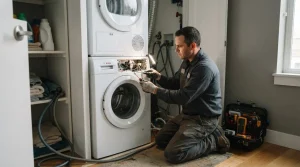
Bay Area laundry spaces are tight. Dryers are tucked into closets with louvered doors, placed under counters in condos, or stacked above a washer on a shared wall. Each arrangement matters for repair.
The vent is the biggest variable. Older buildings often have a long run with several elbows, and a flexible foil duct squeezed behind the machine can crush flat. Airflow trouble looks like a heater failure, so we examine the duct before condemning a heating part. Closet doors without enough opening also starve the dryer of makeup air.
Fuel type changes the entire approach. An electric dryer needs the correct dedicated circuit and a solid cord connection. A gas dryer relies on a shutoff valve, a flexible connector and a clean exhaust path. If you ever smell gas, leave the home, avoid light switches and phones inside, and call the gas utility or 911 from outside. Do not try to find the leak yourself.
For stacked laundry units that share a cabinet, see our laundry center repair page, because a shared control and a single power cord change what we can isolate.
Please do not remove the back or front panels, test live wiring, adjust gas fittings or bypass a door switch. Those steps are for the technician.
Turn the dryer off and leave it alone if you notice a burning smell, scorched laundry, a casing that is too hot to touch, sparks, or a breaker that trips every time you start a load. For burning smell or sparks, switch the circuit off at the breaker. Gas odor means leaving the home first. Running the machine again to see what happens only risks a larger repair, or a fire.
Frigidaire dryers share a family look, but heating assemblies, control boards, drum supports and vent connections differ from one model to the next. The model label is usually found inside the dryer door opening, on the frame or the door itself. Photograph it and send it with your request. Our model library includes dryers such as the FDEX21E4EW and the FDGX21E4EW, and knowing the exact number lets the technician arrive with the right expectation of what the machine contains.
You book through the request form and tell us the symptom, the code if there is one, and the model number. The technician arrives in the scheduled window, listens to the problem again, tests the dryer and explains the finding in plain terms. You get the written estimate, you decide, and only then does repair begin. If a part has to be ordered, we explain what is pending and what the dryer can safely do in the meantime, which is often nothing.
For the product lineup and where each model label sits, visit the Frigidaire dryers guide. If your washer is acting up too, our washer repair page covers that side of the laundry pair.
Weak airflow is the most frequent reason, followed by a failed heating part or a thermistor that ends the cycle early. The technician checks airflow first because it is quick and often explains everything.
A blocked vent traps heat and lint. Stop using the dryer until the path is clear, because the machine is working against itself and the risk grows with every load.
Yes. Tell us which fuel your dryer uses when you book so the visit is planned around the right heating system, and keep the gas valve in view for the technician.
Often the technician can reach what is needed with the stack in place, but some jobs require pulling the units apart. We explain that in the estimate before any work begins.
You will hear that during the estimate. Diagnosis comes first, and you are never asked to approve a repair you do not want.
Electric and gas Frigidaire dryers: damp loads, no heat, noise and display codes, plus the vent and breaker checks that belong at…
Window, through-the-wall and portable Frigidaire room air conditioners diagnosed in San Francisco flats and homes, installation included, with a written estimate first.
Gas, electric and induction Frigidaire cooktops checked in San Francisco kitchens, from dead zones and touch controls to induction codes, with a…
Diagnosis and repair for Frigidaire dehumidifiers that run without collecting water, frost over, leak, show a code or fail to pump out…
Standing water, a dead panel, a door that will not latch or cloudy glasses: Frigidaire dishwasher faults are traced through water, drain,…
Upright or chest Frigidaire freezer not freezing, building frost or cycling nonstop? We diagnose the cause first and give a written estimate…
No ice, hollow cubes, jams or leaks from a Frigidaire ice maker? We trace water, cold and controls, then give a written…
Stacked Frigidaire laundry centers in closets and small flats, with the washer and dryer halves tested separately and the shared parts checked…
Over-the-range, built-in and countertop Frigidaire microwaves examined in San Francisco, with the problem named before any repair is approved.
Gas, electric and induction Frigidaire ranges: burners that will not light, oven temperature that drifts, locked doors and F codes, diagnosed before…
Warm fresh-food section, no ice, frost, leaks or error codes on a Frigidaire refrigerator? We diagnose first and send a written estimate…
Single, double and oven-microwave Frigidaire wall ovens diagnosed in San Francisco homes, with a written estimate before any repair begins, every time.
Frigidaire front-load or top-load washer not draining, shaking, leaking or showing an E code? We diagnose first and give a written estimate…
Diagnosis and repair for Frigidaire wine coolers that run warm, cycle nonstop, sweat, rattle or lose their display, with a written estimate…
Share a few details and we’ll confirm an appointment. Prefer to talk? Call us and we’ll help right away.