Freezers
Upright and chest Frigidaire freezers in garages, basements and laundry closets: why they lose cold, frost over or run nonstop, and what…

Specialized Frigidaire Appliance Repair in San Francisco
Mon–Sat: 8:00 AM – 7:00 PM
Soft ice cream, thick frost or a compressor that never rests? We trace the fault in upright and chest freezers before recommending any repair.
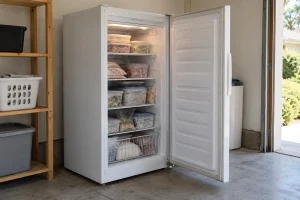
A freezer works quietly until the day it does not, and by then the contents may already be softening. In San Francisco, freezers live in some unusual places: a back-porch alcove in a Victorian flat, a basement storage room under a row house, a garage in the Sunset or Daly City, a laundry closet in a condo. Frigidaire upright and chest freezers are common in all of them, and each location brings its own way of failing. Our freezer repair work focuses on finding the real cause before any part is replaced.
Ice cream that is soft but not melted, or food that has partly thawed and refrozen, usually points to a cooling circuit that is running but not keeping up. A technician looks at the condenser fan and coils, the compressor start components, the evaporator and its fan on frost-free uprights, and the thermostat or temperature control that tells the compressor when to run. Lint and pet hair on condenser coils are a surprisingly frequent culprit in basements and utility rooms.
A frost-free upright is supposed to melt its own frost on a schedule. When thick frost covers the back wall or the evaporator cover, the defrost heater, the defrost thermostat or the control that triggers the cycle is under suspicion. On a manual-defrost chest freezer, a lid that does not seal lets in moist air and grows frost along the rim, so the gasket matters as much as anything inside.
A freezer that never shuts off may be fighting a door left slightly ajar, a worn gasket, a dirty condenser, or a unit squeezed into a space with no room to breathe. Short, repeated cycles can point at a start relay or an overload that is tired. These faults waste electricity and age the compressor, so they are worth chasing early.
Rattling is often a loose tray, a fan blade touching frost or a drain pan out of place. A musty smell after a power cut suggests spoiled food or a blocked drain. Water on the floor under an upright points to a blocked defrost drain or a door that does not seal. Heat and humidity can also make a chest freezer sweat along the outside of the cabinet.
We start with questions: how long has it been wrong, did the power go out, was the door left open, has the unit been moved? Then the technician checks the surroundings and the seal before touching anything inside. Temperatures are measured with a thermometer rather than trusted to a dial. We listen to the compressor and fan, look at the condenser, inspect the evaporator area where it can be reached, and test the controls that govern defrost and temperature.
When the cause is clear, you get a written estimate that names the fault and the work needed. We repair nothing until you approve it, and if a freezer is not worth fixing we will tell you so plainly. Diagnosis before repair is the rule, not an option.
Placement is half of freezer reliability. Garage units face cold nights and warm afternoons, and some freezers struggle to regulate when the surrounding air changes a lot. A chest freezer pushed against a wall with no gap cannot shed heat. Uprights that are not level leave doors drifting open. Extension cords and shared circuits cause nuisance trips, so a freezer should have its own outlet where possible. In older buildings the outlet itself may be loose or only intermittently live, which can look like a failed freezer when the unit is fine.
If your freezer is the lower section of a tall refrigerator-freezer instead, you will probably want our Frigidaire refrigerator repair page, because the cooling system is shared.
We have no verified code list for stand-alone Frigidaire freezers, so we do not guess at meanings. If your unit shows a flashing light or a number, write down exactly what you see and when it began. The household error code library covers other Frigidaire products, and the high-temperature alarm described under refrigerator code H is a useful comparison for combination units that report it.
Do not take off rear panels, use a hair dryer or a tool to speed up defrosting, puncture ice from walls with a blade, or touch the sealed refrigeration tubing.
Stop using the freezer and switch off its breaker if you smell burning, hear a loud buzz, see scorching at the plug or find the cord warm. Do not refreeze food that has fully thawed. If the freezer has been warm for an unknown time, think carefully about what is safe to keep. Moving frozen items into a neighbor’s freezer or a cooler with ice keeps them cold while a repair is arranged.
Upright and chest freezers use different parts even within one brand. The label is usually inside the cabinet on a side wall, near the top of the opening, or along the door frame. Send us a photo with your request. As an example, see the Frigidaire FFUE0725AW freezer.
You tell us the model, the symptom and what you have already tried. We confirm the details, set a time and tell you what to prepare, which is usually clear access and a freezer you can pull a little forward if needed. The technician diagnoses, explains the finding and presents the written estimate. After your approval, the repair is made and the freezer is tested before the technician leaves.
The Frigidaire freezers guide describes the lineup. Related reading on a similar cold-air fault is condensation around refrigerator doors, which covers gasket problems you can spot yourself, and you can always request a visit.
Uneven cooling often means airflow is restricted or the unit is overloaded. Clearing blocked vents and spacing items out can help, but a frost-free upright may also have a fan or defrost problem that needs a technician.
You can unplug a manual-defrost chest freezer, empty it and let it thaw naturally. On a frost-free upright, heavy frost is a symptom of a deeper fault, and chipping at it can damage the evaporator.
That depends on the fault, the age of the unit and the condition of the cabinet. We explain the diagnosis, and you decide with the written estimate in front of you.
If the noise is a rattle from a tray, probably yes. If it is a loud buzz, grinding or the unit smells hot, switch it off at the breaker and arrange a visit.
No. You get a diagnosis and a written estimate, and nothing is repaired without your approval.
Upright and chest Frigidaire freezers in garages, basements and laundry closets: why they lose cold, frost over or run nonstop, and what…
Window, through-the-wall and portable Frigidaire room air conditioners diagnosed in San Francisco flats and homes, installation included, with a written estimate first.
Gas, electric and induction Frigidaire cooktops checked in San Francisco kitchens, from dead zones and touch controls to induction codes, with a…
Diagnosis and repair for Frigidaire dehumidifiers that run without collecting water, frost over, leak, show a code or fail to pump out…
Standing water, a dead panel, a door that will not latch or cloudy glasses: Frigidaire dishwasher faults are traced through water, drain,…
Frigidaire dryers that run but stay damp, will not heat, stop mid-cycle or show a code: diagnosis first, written estimate, nothing repaired…
No ice, hollow cubes, jams or leaks from a Frigidaire ice maker? We trace water, cold and controls, then give a written…
Stacked Frigidaire laundry centers in closets and small flats, with the washer and dryer halves tested separately and the shared parts checked…
Over-the-range, built-in and countertop Frigidaire microwaves examined in San Francisco, with the problem named before any repair is approved.
Gas, electric and induction Frigidaire ranges: burners that will not light, oven temperature that drifts, locked doors and F codes, diagnosed before…
Warm fresh-food section, no ice, frost, leaks or error codes on a Frigidaire refrigerator? We diagnose first and send a written estimate…
Single, double and oven-microwave Frigidaire wall ovens diagnosed in San Francisco homes, with a written estimate before any repair begins, every time.
Frigidaire front-load or top-load washer not draining, shaking, leaking or showing an E code? We diagnose first and give a written estimate…
Diagnosis and repair for Frigidaire wine coolers that run warm, cycle nonstop, sweat, rattle or lose their display, with a written estimate…
Share a few details and we’ll confirm an appointment. Prefer to talk? Call us and we’ll help right away.