

Specialized Frigidaire Appliance Repair in San Francisco
Mon–Sat: 8:00 AM – 7:00 PM
Water sitting in the drum after the cycle ends is stressful, especially in a closet. Learn what blocks the drain path, which codes apply and what to check before booking.
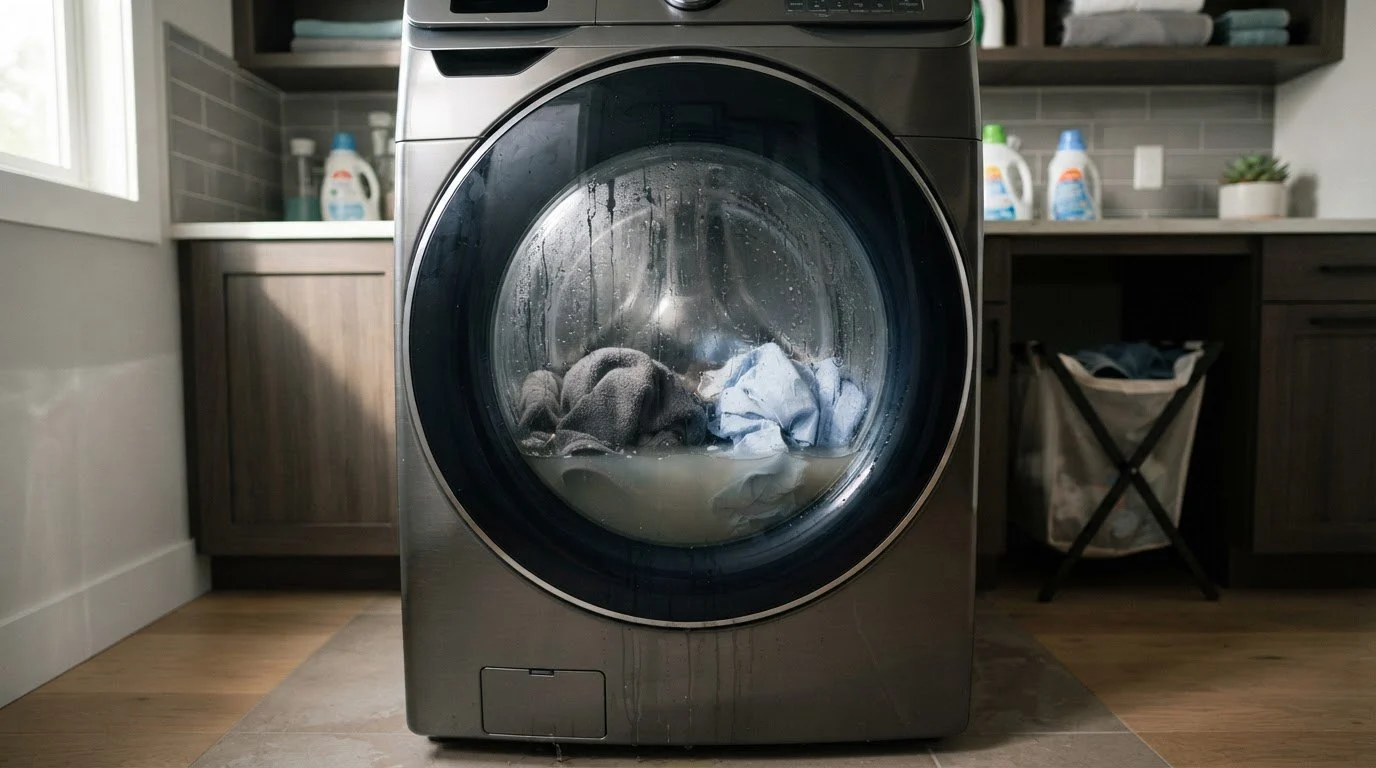
The cycle ends, the lid or door stays locked, and you can see a pool of grey water in the drum. Sometimes the washer pauses before the spin and sits with a full tub. Clothes are soaked, the door will not open, and the question is whether you are dealing with a simple clog or a failed part. A Frigidaire washer drains through a path with several links: the tub outlet, the pump and its filter, the drain hose, and the standpipe or sink trap in the wall. A fault in any link keeps the water in.
Many Frigidaire washers show a code when the water does not leave in time. It describes code E2 as water that takes too long to drain or is not draining, and code E21 as water not pumping out fast enough. Code EF1 names a clogged drain pump. A pump electrical fault appears as code E23, where the relay on the control board failed, a wire came off the pump or the pump itself is defective. Write down the exact letters and numbers before you reset anything.
Coins, hair ties, socks, bra wires and tissue are the classic culprits. They slip past the tub holes and wedge in the pump filter or impeller. The pump hums but cannot move water, or it runs with a rattle. Clearing the pump filter requires opening the access panel and handling standing water, and that is a job for a technician unless your manual explicitly describes it for your model.
The hose behind the washer often gets folded when the machine is pushed back against the wall. In a stacked closet installation, where there are a few inches of clearance, kinks are very common. A kinked hose slows the drain to a trickle or stops it entirely.
The hose empties into a standpipe, a laundry sink or a floor drain. If lint, soap scum and hair clog the line, water backs up into the hose and shows as gurgling and a slow drain, sometimes with water rising in the standpipe. Check whether a sink beside the washer also drains slowly.
If the hose end rises above the allowed height, the pump struggles. If it is pushed down the standpipe so far that it seals, the water siphons or backs up. Older San Francisco buildings with shared plumbing and unusual standpipe heights show these problems often.
Suds stop a pump from moving water, and the washer may sit with froth in the drum. Code EF2 means too much soap. Heavy loads that wrap into a ball can also block the outlet.
If the path is clear and the pump is silent, the motor may have failed, or the board may not be calling for it. This needs a diagnosis with the cabinet open.
Listen when the drain step begins. A pump that hums but moves nothing is probably jammed or struggling against a blocked hose. A pump that makes no sound at all suggests an electrical break, a failed relay or a board that is not sending the signal. Look at the water, too: clear water with a little soap means a simple stall, while thick grey water with lint and hair floating in it signals a clog that has been growing for months. Water that rises in the standpipe or sink beside the washer is a plumbing backup, not a washer fault. These small observations let a technician arrive with a plan for your particular machine.
Do not tip the washer, bail water from the drum with the door forced open, or pull the drain hose off while the tub is full; the water will pour out on the floor. Do not use drain chemicals in the standpipe, which can damage seals and splash back. Do not keep repeating cycles with a full tub, since the pump may overheat. If the washer sits on an upper floor or over a downstairs neighbor, treat leaks as urgent in the sense that you should shut the water supply and stop using it.
If the hose and standpipe are clear and the washer still holds water, the pump or its circuit needs a hands-on diagnosis. Our Frigidaire washer repair visit begins by tracing the whole drain path, then you get a written estimate, and nothing is repaired without your approval. For the lineup see Frigidaire washers, and note the model entries for FWFX22D4EW and FAFW3577KR. Another drain-related symptom is covered in leaking from the door, dispenser or base.
The lock stays engaged while water is in the drum as a safety measure. Once the water drains or the power is switched off and the lock releases, the door opens.
If the washer has a drain tube or filter described in your manual, you can follow it carefully with towels and a shallow pan. Otherwise leave it for a technician.
Not always. Gurgling often means the wall plumbing is partly blocked. If a sink nearby also drains slowly, call a plumber before the washer.
In the code library it means water takes too long to drain or is not draining. It is a symptom, not a diagnosis, so the path still has to be checked.
The principle is similar, but access to the pump differs. The model number tells the technician how your washer is built.
Share a few details and we’ll confirm an appointment. Prefer to talk? Call us and we’ll help right away.