Air Conditioners
Window, through-the-wall and portable Frigidaire room air conditioners: the models, label locations, common faults and safe first checks.

Specialized Frigidaire Appliance Repair in San Francisco
Mon–Sat: 8:00 AM – 7:00 PM
Weak cooling or a wet floor often traces back to airflow or installation before it traces to the machine. We check both.
San Francisco is not famous for heat, but warm spells come, top-floor flats trap the afternoon sun, and a good number of buildings have no central cooling at all. That is when a room air conditioner earns its place, and when it quits at the worst moment. Frigidaire room air conditioners are built as window units, through-the-wall units and portable units, and the installation is as much a part of the diagnosis as the machine. We diagnose first, give a written estimate, and do nothing without your approval.
The fan blows, the compressor seems to run, and the air is only mildly cool. Before suspecting the sealed system, a technician looks at airflow: a clogged filter, an evaporator coil coated in dust, or a condenser at the back that cannot shed heat. Our guide room air conditioner not cooling lists the checks in order. An actual refrigerant problem exists, but it is the last thing to conclude, not the first.
Air conditioners remove moisture, and that water has to leave the unit. A window unit is meant to tilt slightly so water drains outward, a through-the-wall unit relies on a drain path and a level sleeve, and a portable unit collects water in a pan or pushes it through a hose. Dripping indoors usually means the tilt is wrong, the drain is clogged, or the pan is full. See room air conditioner leaking water inside for the typical causes.
Ice on the coil blocks air, which reduces cooling further and eventually melts into a puddle. Low airflow is the common trigger, with dirty filters leading the list, and a low charge is possible but needs measurement to confirm.
A unit that does nothing may have a bad cord set, a failed control board, a dead remote sensor, or a blocked power supply. One that trips the breaker may share a circuit with something else, or have a compressor or capacitor trouble. A unit that turns on and off every few moments may be sensing the room temperature incorrectly or overheating.
Rattling is often loose window brackets or panels. A grinding or squeal can come from the fan motor or its bearings. A musty smell comes from moisture in the filter or pan and is usually a cleaning issue.
The visit begins with how the unit is installed, because installation problems are mistaken for failures all the time. The technician checks the cord and outlet, the filter, the coil faces, the fan and the drain path, then the electrical side: control, thermistor, capacitor, and the compressor circuit. The finding is explained, a written estimate is prepared, and only your approval starts the repair.
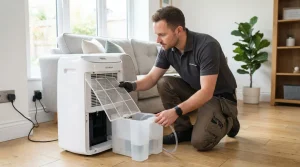
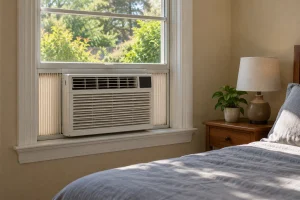
Window units sit on a sill held by side panels and brackets. A sill that slopes the wrong way sends condensate back into the room, and loose side panels let warm air leak around the unit. Through-the-wall units live in a metal sleeve, and a sleeve that is out of level, full of debris or missing its seal affects both drainage and cooling. Portable units need their exhaust hose to run to a window kit or vent without kinks or long runs, and a condensate hose, if used, has to slope down to a drain or bucket.
Older San Francisco buildings add wrinkles: sash windows that cannot hold a heavy unit, shared outdoor walls with building rules about what hangs outside, and old circuits where the AC competes with a space heater or kettle. An extension cord is never a fix. If the building manager controls the outlet or the sleeve, let us know so we can plan the access.
Please do not remove the outer cabinet, bend the coil fins, or open the sealed refrigeration circuit.
Unplug it and keep it off if the cord or plug is hot or discolored, if you smell burning, if the breaker trips repeatedly, or if water is running toward a wall, floor or outlet. A unit that hangs loose in the window should be secured or taken in before anyone leans on it, especially in an upper-floor flat.
Boards, fans, thermistors and remote sensors vary by model. The label is usually on the side panel of the unit, which you can often see by sliding the chassis forward or checking the sides, and portable units show it on the back or the base. Models covered include the FHTC085WC1, FHTC105WC1, FHTC125WC1 and FHTC145WC2, along with the FHWC055TF1 and FHWC056TF1. Send the full label as printed, and we will not need to guess.
You tell us the type of unit, where it is installed and what happens. The technician looks at the installation, reproduces the fault, and explains what failed. The estimate is written, and you decide whether to go ahead. Units that are bulky or mounted high may need a second person for safe removal, which we will mention before the visit.
For the lineup and label locations, see Frigidaire air conditioners.
Most often the unit is not tilted slightly to the outside, the drain is blocked, or the coil has iced and is now thawing. Check the tilt and filter, then book if it persists.
It is possible, but airflow problems are much more common. A technician confirms by measurement and does not assume.
No. The hose carries hot air that has to go outdoors or into a proper vent, or the unit works against itself.
No. Extension cords and power strips can overheat under the load of an air conditioner. Use a wall outlet suited to the unit.
We look at the sleeve level, drainage and seals as part of the diagnosis and tell you what we find in the written estimate.
Window, through-the-wall and portable Frigidaire room air conditioners: the models, label locations, common faults and safe first checks.
Gas, electric and induction Frigidaire cooktops checked in San Francisco kitchens, from dead zones and touch controls to induction codes, with a…
Diagnosis and repair for Frigidaire dehumidifiers that run without collecting water, frost over, leak, show a code or fail to pump out…
Standing water, a dead panel, a door that will not latch or cloudy glasses: Frigidaire dishwasher faults are traced through water, drain,…
Frigidaire dryers that run but stay damp, will not heat, stop mid-cycle or show a code: diagnosis first, written estimate, nothing repaired…
Upright or chest Frigidaire freezer not freezing, building frost or cycling nonstop? We diagnose the cause first and give a written estimate…
No ice, hollow cubes, jams or leaks from a Frigidaire ice maker? We trace water, cold and controls, then give a written…
Stacked Frigidaire laundry centers in closets and small flats, with the washer and dryer halves tested separately and the shared parts checked…
Over-the-range, built-in and countertop Frigidaire microwaves examined in San Francisco, with the problem named before any repair is approved.
Gas, electric and induction Frigidaire ranges: burners that will not light, oven temperature that drifts, locked doors and F codes, diagnosed before…
Warm fresh-food section, no ice, frost, leaks or error codes on a Frigidaire refrigerator? We diagnose first and send a written estimate…
Single, double and oven-microwave Frigidaire wall ovens diagnosed in San Francisco homes, with a written estimate before any repair begins, every time.
Frigidaire front-load or top-load washer not draining, shaking, leaking or showing an E code? We diagnose first and give a written estimate…
Diagnosis and repair for Frigidaire wine coolers that run warm, cycle nonstop, sweat, rattle or lose their display, with a written estimate…
Share a few details and we’ll confirm an appointment. Prefer to talk? Call us and we’ll help right away.