Dehumidifiers
Frigidaire dehumidifiers for damp Bay Area basements, garages and ground-floor flats: models, display codes, complaints and safe checks.

Specialized Frigidaire Appliance Repair in San Francisco
Mon–Sat: 8:00 AM – 7:00 PM
Damp basement, fogged windows or an empty bucket in a wet room? We find out what stopped working and give you a written estimate before anything is touched.
A dehumidifier in a San Francisco home usually lives in a place nobody enjoys visiting: a basement room under a Victorian, a ground-floor garage conversion, a closet in a rental, or a corner of a laundry room where the air never quite dries. When it stops pulling moisture, the first sign is not a fault light. It is a damp smell, window fog, or a bucket that has stayed empty for days. We diagnose and repair Frigidaire dehumidifiers across the city and the Bay Area, and we start by working out which of three systems has actually let go: the refrigeration loop, the fans and sensors, or the water-removal path.
The fan blows, the display looks normal, and yet the bucket stays dry in a room that clearly is not. A technician looks at whether the coil is actually getting cold, whether the compressor is starting and holding, and whether the airflow across the coil is blocked by a clogged filter or a covered grille. A unit that moves air but never chills the coil points toward the sealed system, which is a different repair from a dusty filter.
Dehumidifiers are meant to frost slightly and then clear themselves. When they frost heavily and stay frosted, the usual suspects are low room warmth, restricted airflow, or a sensor that is reporting the wrong coil condition. Our post on why a Frigidaire dehumidifier freezes up walks through that symptom in more detail.
Leaks come from a cracked or poorly seated bucket, a kinked or sagging drain hose, a blocked drain outlet, or a full bucket whose float switch did not shut the unit off. A damp patch under the machine is worth tracing before you wipe it up, because the source decides the repair.
No display, a display with no fan, or a unit that starts and quits all separate into power supply problems, control board problems and safety shutoffs. A cord that is warm to the touch or a plug that has darkened is a reason to stop using it, not a reason to keep testing.
Models with a condensate pump can drain upward through a hose to a sink or a floor drain. When that pump hums without moving water, or the unit throws a pump-out message, the bucket fills and the machine shuts off. See the Frigidaire dehumidifier pump troubleshooting post for how that failure presents.
Diagnosis comes before any repair. We read the model label, ask how the unit has been used and where it sits, then check the airflow path, the bucket and float, the drain route, the fan, and the sensor behavior before drawing a conclusion about the compressor or board. The reason for that order is practical. Many dehumidifiers that look dead are blocked, tripped on a safety, or waiting for a sensor reading, and none of that should be solved with a new part until the evidence says so.
If the evidence points to something that needs a part or a sealed-system repair, you receive a written estimate first. Nothing is repaired without your approval, and a unit that is not worth repairing gets an honest conversation about that too.
Write down exactly what the display shows before you unplug anything. The codes we have meanings for are grouped below, each with its own page.
A sensor code does not always mean the sensor is the only problem, and a protection code can be a symptom rather than a cause. The code tells us where to look first.
A dehumidifier in a cold garage conversion behaves differently from one in a warm interior closet. Cool rooms favor frosting, so a unit that frosts in one location may run cleanly in another. A closet or tight alcove restricts intake and exhaust, and that heat has nowhere to go, which stresses the compressor and can trip overload protection. A basement with a floor drain makes continuous hose drainage practical, while a unit running a hose uphill, or across a doorway where people step on it, will fight its own drainage. We note the room, the clearances, the hose route and whether the unit stands level, because each of those can explain a complaint that looks like a part failure.
Do not open the cabinet, test the electrical parts, or work on the refrigerant lines. That is where a technician starts, and where the risk lies for anyone else.
Unplug the unit and keep it off if you see a burning smell, sparks, a scorched plug or cord, water around the plug or outlet, or a bucket that overflows repeatedly. A burning smell or sparking is a reason to switch off the breaker as well. A machine that trips the breaker when it starts should stay off until it has been examined.
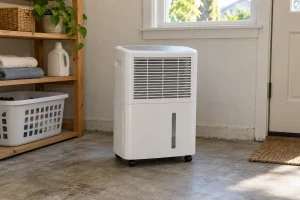
Frigidaire dehumidifiers are built in several generations, and the label tells us which controls, which drain arrangement and which parts the unit has. It is usually on the side panel or the back of the cabinet, and sometimes behind the bucket. Our model pages include the FHDD2233Y1, a current 22 pint model, and the FFAD2233W1, a 22 pint model that is now discontinued. Having the exact number ready before the visit means we arrive knowing which parts to consider, and the full list is on the Frigidaire models page.
You request a visit, tell us the model and what the unit is doing, and we agree on a time window. The technician inspects the unit where it stands, runs it, and explains what the evidence shows. You get a written estimate before any work begins. If you approve it, the repair proceeds; if you do not, you have lost nothing but the time it took to find out. Read more about the whole range on our Frigidaire dehumidifier guide, or request a repair visit when you are ready.
The fan can run while the cooling side has stopped working. A technician checks the filter and airflow first, then whether the coil is actually chilling, which separates a simple blockage from a sealed-system or sensor fault.
Light frost that clears on its own is part of normal operation. Heavy frost that stays, especially in a cool room or a tight alcove, means the airflow, the sensor or the room conditions need a closer look.
PU is listed as a failure to pump out the bucket within the allotted time. Check the hose for kinks and make sure the bucket is seated, then book a visit if it returns.
Codes such as E5 and H3 refer to compressor overload protection. Turn the unit off, let the room ventilate, and have it examined instead of restarting it repeatedly.
It helps a great deal. It is usually on the side panel, back of the cabinet or behind the bucket, and it lets us look up parts and drain arrangements before we arrive.
Frigidaire dehumidifiers for damp Bay Area basements, garages and ground-floor flats: models, display codes, complaints and safe checks.
Window, through-the-wall and portable Frigidaire room air conditioners diagnosed in San Francisco flats and homes, installation included, with a written estimate first.
Gas, electric and induction Frigidaire cooktops checked in San Francisco kitchens, from dead zones and touch controls to induction codes, with a…
Standing water, a dead panel, a door that will not latch or cloudy glasses: Frigidaire dishwasher faults are traced through water, drain,…
Frigidaire dryers that run but stay damp, will not heat, stop mid-cycle or show a code: diagnosis first, written estimate, nothing repaired…
Upright or chest Frigidaire freezer not freezing, building frost or cycling nonstop? We diagnose the cause first and give a written estimate…
No ice, hollow cubes, jams or leaks from a Frigidaire ice maker? We trace water, cold and controls, then give a written…
Stacked Frigidaire laundry centers in closets and small flats, with the washer and dryer halves tested separately and the shared parts checked…
Over-the-range, built-in and countertop Frigidaire microwaves examined in San Francisco, with the problem named before any repair is approved.
Gas, electric and induction Frigidaire ranges: burners that will not light, oven temperature that drifts, locked doors and F codes, diagnosed before…
Warm fresh-food section, no ice, frost, leaks or error codes on a Frigidaire refrigerator? We diagnose first and send a written estimate…
Single, double and oven-microwave Frigidaire wall ovens diagnosed in San Francisco homes, with a written estimate before any repair begins, every time.
Frigidaire front-load or top-load washer not draining, shaking, leaking or showing an E code? We diagnose first and give a written estimate…
Diagnosis and repair for Frigidaire wine coolers that run warm, cycle nonstop, sweat, rattle or lose their display, with a written estimate…
Share a few details and we’ll confirm an appointment. Prefer to talk? Call us and we’ll help right away.