

Specialized Frigidaire Appliance Repair in San Francisco
Mon–Sat: 8:00 AM – 7:00 PM
A puddle on the glass shelf or in the bottom of the fresh-food side usually points to a blocked defrost drain, a leaking supply line or a door that lets in humid air.
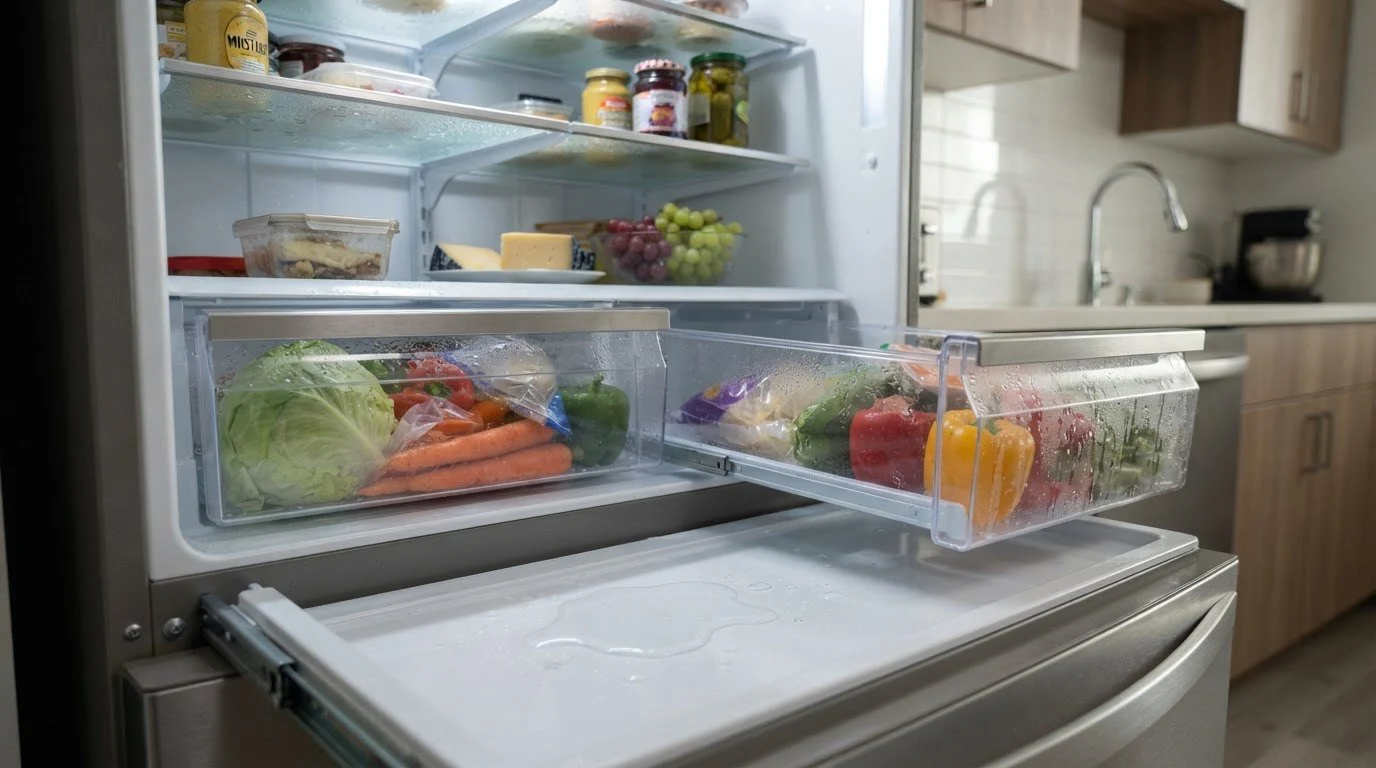
You pull out a crisper drawer to grab celery and find a film of water on the shelf below, or a shallow pool at the back of the cabinet floor. Sometimes it is clear and sometimes it carries a little ice. Occasionally the vegetables sit in it and turn slimy. The first instinct is to blame the drawer, but drawers are rarely the source. Water ends up there because it has travelled from somewhere else, and in a Frigidaire refrigerator that journey usually starts in one of three places.
Where the puddle forms and what it looks like narrows the search before anyone opens a panel.
A frost-free refrigerator builds frost on the freezer evaporator and melts it on a schedule using a heater. That meltwater runs down a small drain, through a tube, to a pan that evaporates it near the compressor. When the drain freezes shut or fills with food debris and ice-cream residue, the meltwater has nowhere to go and finds the next lowest path. That path leads through the back panel into the fresh-food side, where it collects under the drawers. You can often see a sheet of ice at the rear of the freezer floor. The cause is not always the drain itself: a defrost heater, a sensor or a board that no longer starts the defrost cycle will let frost build until it overwhelms the drain even though the drain was clean.
San Francisco fog and rental kitchens with poor ventilation bring a lot of damp air into a home. A gasket that has lost its seal draws that air in each time the door opens, and it condenses on the coldest surfaces inside. If the water forms mainly in the door bins and along the glass shelf, run a clean finger around the gasket and check for gaps, folds or a torn corner. A door that sits slightly open because the unit is unlevel lets in more still. The same cause shows up as beads on the outside, which we cover in condensation around the doors.
If the refrigerator has an ice maker or dispenser, a small weep at a fitting behind the unit, in the door hinge area or at the filter housing can run down inside the cabinet walls. This is usually a slow trickle. Check whether the water appears more after the ice maker has filled, or after you have used the dispenser. If it does, read why a Frigidaire ice maker overfills or leaks.
Do not run a hair dryer or heat gun at the back of the freezer to melt ice, and never poke a wire or screwdriver into the drain opening. The lines behind the liner carry refrigerant and are easy to puncture. Do not siphon the water out with the refrigerator running and the drawers loaded, since it will simply return. And do not leave a wet cabinet unattended if the floor beneath is wood; an old flat with a leaning kitchen floor can pool the water against the baseboard without anyone noticing.
If frost returns after you have cleared it, or the water comes back within a day or two, the drain, defrost heater or defrost control is likely involved. That work happens inside the freezer liner and needs the right tools. Our Frigidaire refrigerator repair service begins with a diagnosis, followed by a written estimate, and no repair goes ahead without your approval. The Frigidaire refrigerators guide lists the lineup and where the model label usually sits, and our pages for FFPE3322UM and FFHT1822UB show how we write up individual units. A temperature display message such as code H alongside the leak is worth mentioning when you call.
Rarely. Drawers can hold condensation from wet produce, but a steady puddle usually travels from the defrost drain, a supply line or a leaky gasket and only collects beneath them.
Ice on the back wall or floor suggests the defrost drain froze shut. The meltwater refreezes on its way down instead of leaving through the tube.
Often yes for a short time, as long as food stays cold and the water does not reach the floor. Dry the area daily and watch for frost, because a growing block of ice can eventually stop airflow.
A loose or cracked filter housing can leak slowly, usually behind a grille or inside the cabinet. If the leak follows dispenser use, closing the supply valve and mentioning the filter helps the technician.
Often, to reach the back of the unit and the drain pan. Clearing a path and measuring the doorway in advance saves time, especially in tight San Francisco kitchens.
Share a few details and we’ll confirm an appointment. Prefer to talk? Call us and we’ll help right away.