

Specialized Frigidaire Appliance Repair in San Francisco
Mon–Sat: 8:00 AM – 7:00 PM
Frozen blocks in the bin, a puddle below the dispenser or water around a freestanding ice maker all point to the fill system. Here is how to narrow it down safely.
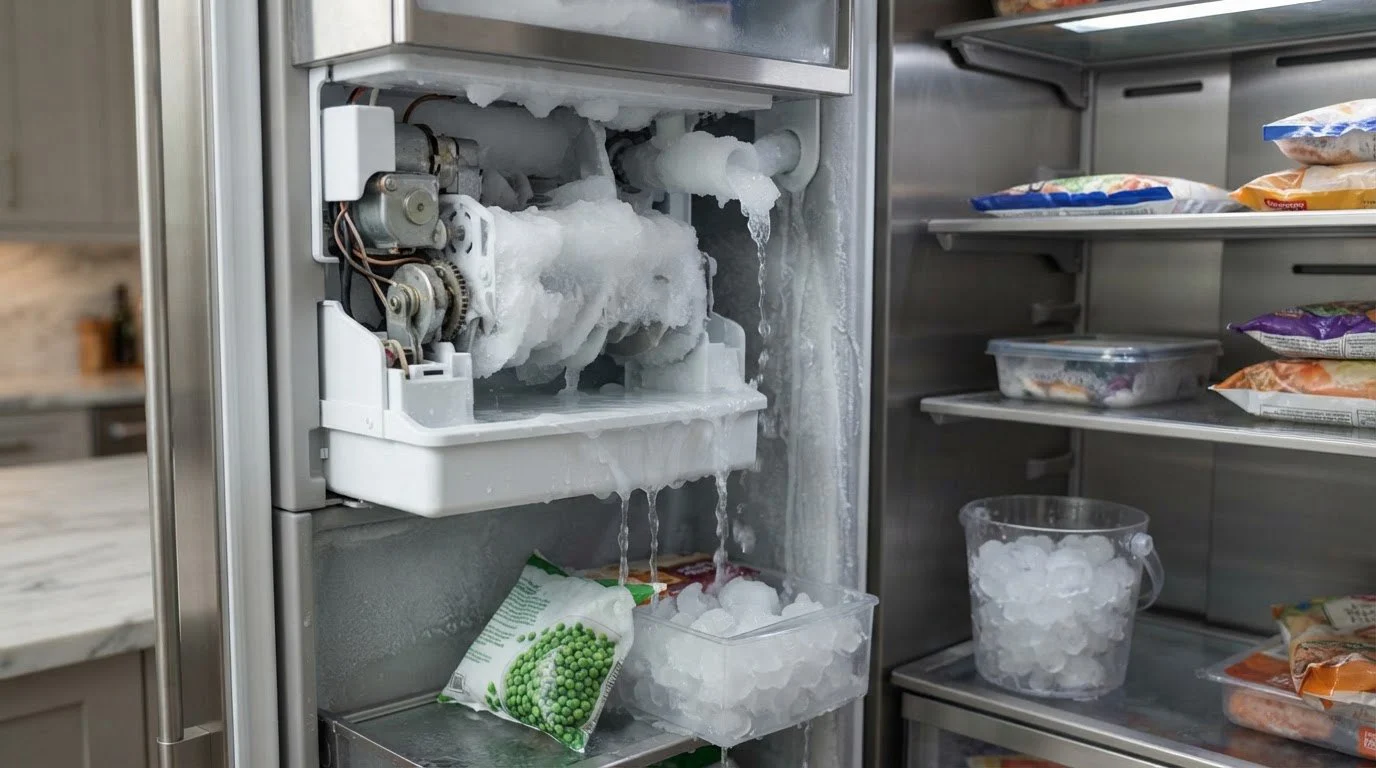
The signs vary. You might find a solid slab of ice stuck to the bottom of the bin, cubes welded together in a single mass, a puddle on the kitchen floor in front of the refrigerator, or a freestanding ice maker with water pooling around its base. In each case the machine has taken in more water than it turned into ice, or the water has found a way out before reaching the tray. Both Frigidaire refrigerator ice makers and freestanding units can do this, and the difference lies in where the water goes next.
A refrigerator ice maker normally works in a loop. A water inlet valve opens briefly, the mold fills, the water freezes, a heater loosens the cubes and an arm or motor sweeps them into the bin. If the valve fails to close fully, a small flow continues and the mold overflows. The extra water freezes into misshapen cubes that fuse in the bin, and in time a frozen layer builds in the compartment. A weak water supply, a partly clogged filter or a dripping valve can cause the same result because the fill is timed rather than measured, so a poor flow gives you small, hollow cubes while a stuck valve gives you too much.
If cubes look normal but water appears under the refrigerator, suspect the plumbing rather than the mold. The usual spots are the saddle valve or shutoff on the wall, the supply tubing along the back, the connection to the inlet valve and the filter housing. A kink in the tube behind a refrigerator that has been pushed back against the wall can cause a pinhole or a loose compression fitting. In a flat or condo where the refrigerator sits in a recess, the water can run along the floor for some distance before you see it. For a drip at the dispenser, a cracked tube or a frozen fill spout inside the door is more likely, and water can run down the door liner and appear in the dispenser well.
These have a reservoir, a pump and a drain. If the unit leaks, check whether it is level, whether the drain plug or hose is seated, and whether the reservoir cover closes. Melted ice normally drains to a reservoir; if that flow is blocked, water overflows the pan. In a closet or under-counter nook the unit also needs air around it, and warm air melts ice faster, which looks like a leak but is really the machine working too hard.
Ice trapped in the dispenser chute can produce meltwater around the opening. Some Frigidaire controls announce this with a tone and a message described as code DI SP, an ice jam in the dispenser chute. Clearing the visible ice from the chute opening with your hand, with the unit off, is often enough to resolve it.
Never use a knife, screwdriver or ice pick to free the mold, since a jab can cut the wiring or puncture the tray. Do not pour hot water into the ice compartment, and do not keep the supply open if you see a steady drip. If water has reached the floor near an outlet or the power cord, unplug the unit only if the cord is dry and you can reach it without stepping into the water; otherwise switch off the breaker. A loose fill tube that rubs a wire is a good reason to stop using the ice maker until the machine is looked at.
If the ice maker repeatedly overfills, the leak returns after you dry it, or you cannot find any external fitting that is wet, an inside component such as the inlet valve or fill spout is likely at fault. Our Frigidaire ice maker repair visit begins with a diagnosis of the valve, tubing and mold, then a written estimate, and we repair nothing without your approval. Read the Frigidaire ice makers overview to see which kinds we service. If the water also appears inside the fresh-food side, compare it with water under the crisper drawers, and for a refrigerator with a built-in maker see how we describe FFTR2045VB or GRFC2353AF.
Cubes fuse when meltwater refreezes, which happens after the bin sits unused, after an overfill or when the door has been left ajar. Empty the bin, break up the clump by hand and watch the next batch.
Water near electrical parts is a concern. Shut the supply valve, dry the floor and stay clear of the cord and outlet if they are wet. If water has reached them, turn power off at the breaker before touching anything.
A restricted filter lowers the flow and makes small cubes. A leaking filter housing or a loose connector makes puddles. It rarely makes a tray overfill by itself.
Many drain melted ice to a reservoir or through a hose. If that route is blocked or the unit sits unlevel, water can overflow the pan and look like a leak.
Describe where the water appears, whether it follows a fill cycle, what the ice looks like and the model number, which is usually on a label inside the cabinet or on the side panel.
Share a few details and we’ll confirm an appointment. Prefer to talk? Call us and we’ll help right away.