

Specialized Frigidaire Appliance Repair in San Francisco
Mon–Sat: 8:00 AM – 7:00 PM
An oven that runs hot or cool with no code on the display still has a cause. Learn how a sensor, a thermostat control and a plain thermometer test help separate the possibilities.
Burnt edges at the stated time, or a roast that is still raw, can mean the oven is not what the dial says. What makes it confusing is that the display shows no error. Oven controls only raise a fault when a reading falls outside what they expect; a sensor that reads a little wrong looks perfectly healthy to the control. The oven may heat to a set point it thinks is right, while the cavity sits well away from that.
The code Frigidaire range F10 is a runaway temperature alert, where the oven detects higher-than-normal temperature as a safety alert. It appears when the oven has gone beyond a limit. An oven that is simply a little off does not trip it, and the owner is left with food that does not cook as written. If you do see F10, switch the oven off and do not run it again before it is checked. On wall ovens the same code has a related meaning described in Frigidaire wall oven F10.
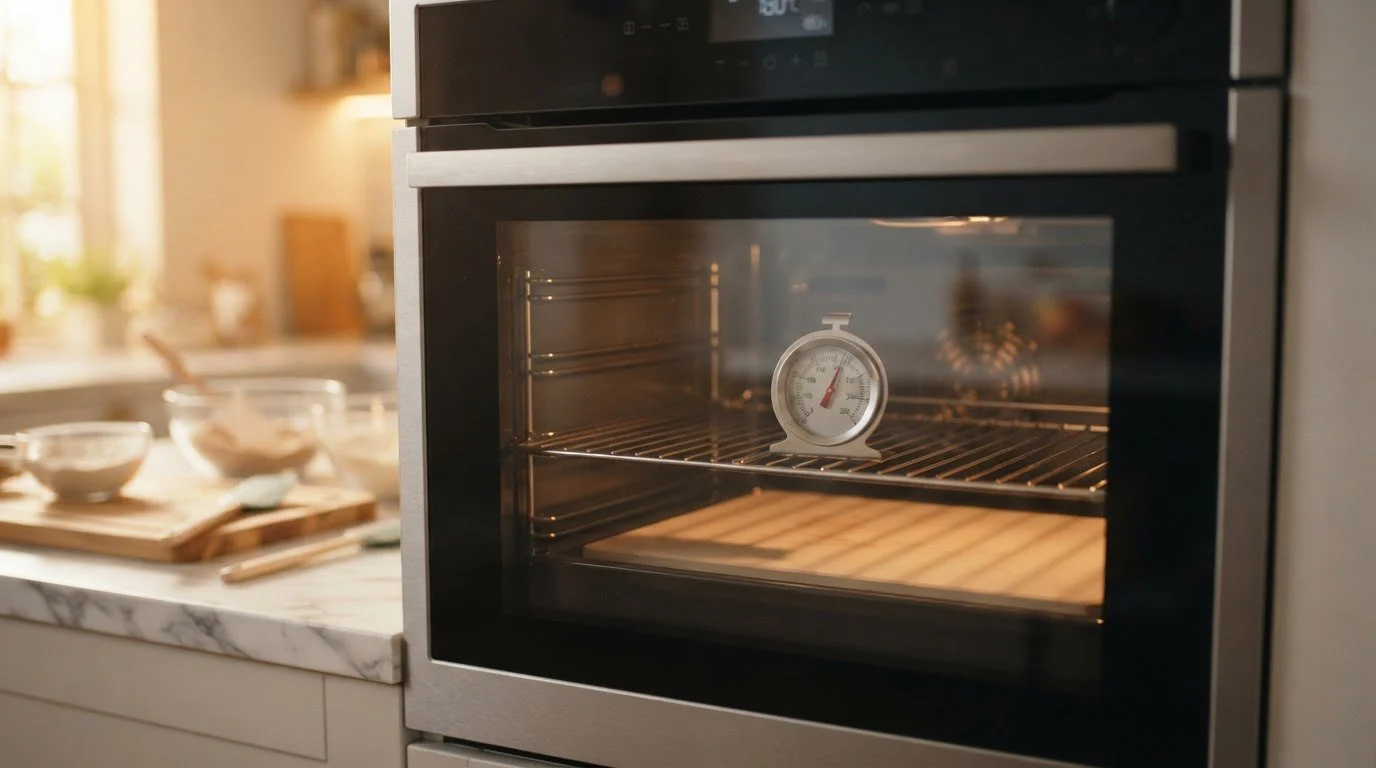
An inexpensive oven thermometer hung from the center rack tells you more than guessing from cooking results. Preheat to a moderate setting, wait until the preheat signal and then a little longer, and read the thermometer. Compare it with the setting. Do the test twice on separate days. Ovens cycle up and down around their set point, so a mid-cycle reading may be a little off; the average over a longer time is what counts. If the thermometer agrees with the display, the cooking problem is probably recipe, pan or position.
A slim probe in the back of the cavity reports temperature to the control. As it ages, its resistance drifts. A drifted sensor makes the oven run hot or cool consistently without any fault code. A sensor that fails entirely produces a code such as Frigidaire range F3, which describes an oven sensor that is open or shorted. A probe that is bent against the wall, or one coated with baked-on grease, can also read incorrectly. Owner cleaning of the cavity is fine; bending the probe is not.
Many Frigidaire controls allow a temperature offset to be adjusted from the keypad, as described in the owner manual. A previous user, a power surge or a stray keypress can change it. Look up your model’s instructions and compare the setting with what the manual calls normal. A relay on the control board that sticks closed lets the oven heat past its set point, while a weak relay may let the temperature sag. A failing control sometimes shows odd symptoms such as a preheat that never finishes or a display that disagrees with the clock.
On an electric range such as the Frigidaire PCFE3080AF, the oven depends on bake and broil elements. A weak element makes the oven run cool and slow to preheat. A gas range such as the Frigidaire GCFG3060BD relies on a safety valve and igniter, and a weak igniter delays the burner and drops the temperature. Both are technician items. The discontinued Frigidaire FPEF3077QF is an older example of an electric range we still service.
A worn door seal lets heat escape, so the oven struggles to hold its set point. A vent blocked by foil or a baking sheet pushed against it traps heat in one area. A range sitting hard against a back wall can restrict its own ventilation. In compact San Francisco flats where the oven is also a source of heat for the room, drafts from an open window can add to uneven readings.
Do not lower or raise settings every day to compensate without finding the cause. Do not run the self-clean cycle in the hope of resetting the oven. Do not open the rear cover or touch the sensor wires. And never block a gas oven’s vent or air supply. If you smell gas, leave the home, avoid switches, and call the gas utility or 911 from outside.
A few lines of notes make a diagnosis much faster. Write the setting, the thermometer reading after a long preheat, the time it took to preheat, and whether the oven seemed to cycle on and off normally. Add the date and whether the kitchen was warm. A pattern such as always hot, always cool or wandering tells a technician which part to suspect long before the oven is opened, and it gives you a record of how the oven behaves over weeks.
Book if the thermometer test shows a consistent difference from the setting, if the oven takes unusually long to preheat, if the temperature swings widely, or if F10 or F3 appears. We diagnose before repair, provide a written estimate, and repair nothing until you approve it. The label is usually inside the oven frame. See Frigidaire range repair and the Frigidaire ranges guide. If the problem is uneven browning instead, read Frigidaire oven bakes unevenly.
The sensor may have drifted, so the control believes the cavity is cooler or hotter than it is. A thermometer test shows the gap.
F10 is a runaway temperature safety alert. A modest offset triggers nothing.
As a short workaround, yes, but it hides the cause. A diagnosis finds the sensor, element or control behind it.
No. A weak igniter on gas, a sensor reading wrong or a leaking door seal can all cause it.
Two separate preheat runs on different days give a reliable picture.
Share a few details and we’ll confirm an appointment. Prefer to talk? Call us and we’ll help right away.