

Specialized Frigidaire Appliance Repair in San Francisco
Mon–Sat: 8:00 AM – 7:00 PM
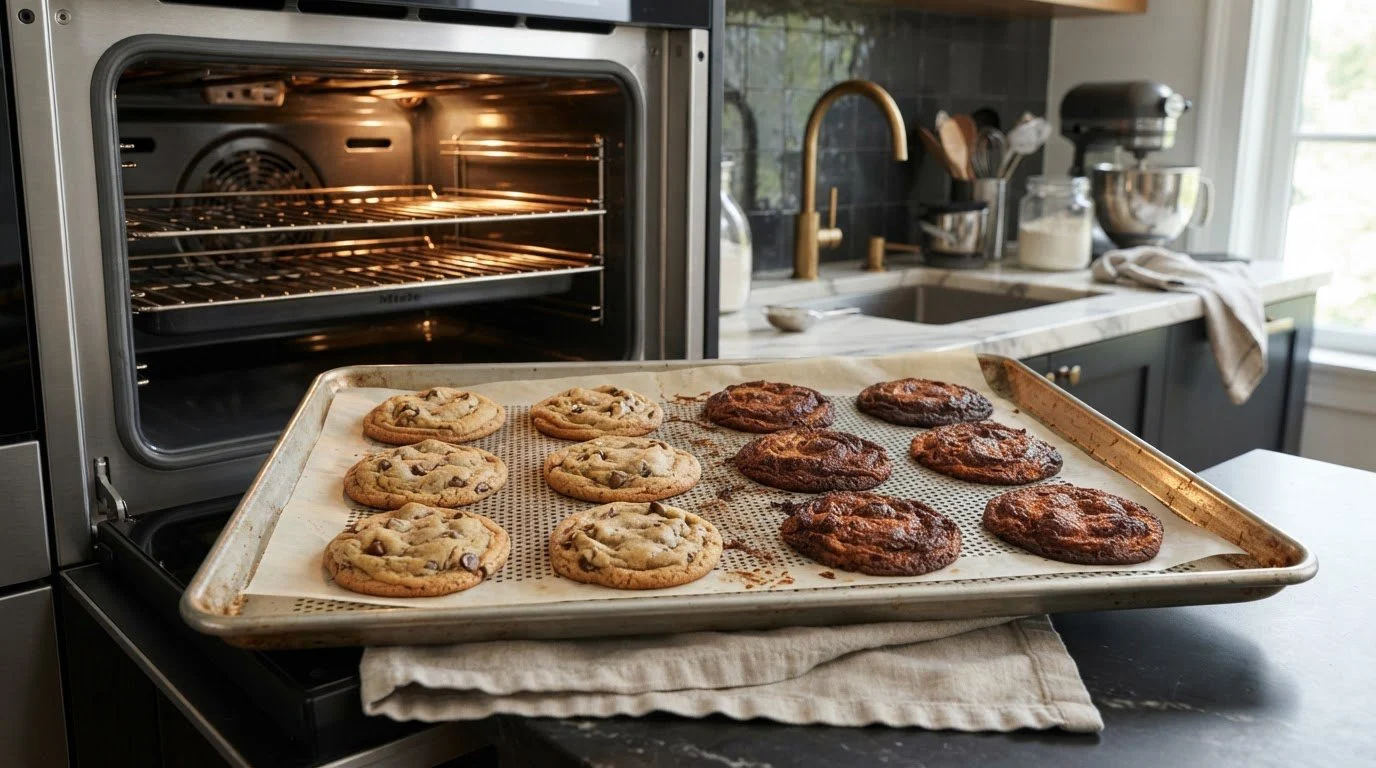
If one side of the cookie sheet browns first or the cake leans, a Frigidaire oven may have an element, fan, rack or door-seal problem. Check these before you retest.
One tray of rolls is golden at the back and pale at the front. A cake rises higher on the left. A pizza scorches on one edge while the other stays soft. Every oven has some hot spots, but a Frigidaire oven that suddenly bakes lopsided, or one that never did before, may have a fault worth finding. Whether you cook on a gas range, an electric range or a wall oven, the same few areas explain most cases.
Oven racks matter more than most cooks think. A tray on a high rack sits near the broil element and browns the top first. A tray on a low rack catches more bake-element heat on the bottom. Using two trays at once blocks the flow of heat, and a tray that is bigger than the rack leaves no gap for air along the walls. Dark pans absorb more heat than shiny ones, and a warped pan makes a puddle of batter that cooks unevenly. Foil laid across the whole rack, or a sheet pushed to the back, can redirect heat to one corner.
Turn the pan halfway through baking as a test. If the dark spot moves with the pan, the pan or the load is the cause. If the dark spot stays in the same corner of the oven, the heat itself is uneven.
In an electric oven the bake element along the floor and the broil element at the top should glow evenly when they work. A section that stays dark, a blister on the coil, or a coil with a sagging end signals a weak element. Radiant electric ranges such as the Frigidaire GCFE3060BF and induction-style ranges like the Frigidaire PCFI3080AF are controlled differently from gas ovens, but all depend on the oven cavity heating evenly. In a gas oven, a burner that has a lazy flame in one section, or ports clogged with spilled food, sends heat to one side, and the flame pattern changes the whole bake.
Convection models move hot air with a fan at the back of the cavity. A fan that has slowed, or one blocked by a tray pushed against its cover, will leave dead spots. Listen for the fan during preheat. A rattling or silent fan on a model that normally runs one tells you something is wrong. Feature names such as Total Convection or Air Fry belong to certain Frigidaire lines, and whether your oven has them is on the model label or in the manual.
A door gasket that is torn or compressed lets heat leak around the frame, and the side nearest the leak cooks more slowly. Close the door on a strip of paper; if you can pull it out with no resistance in one spot, that part of the seal is weak. An oven vent that is blocked by a pan, or foil that covers the vent, changes airflow and holds heat in at one side.
The oven sensor tells the control how hot the cavity is. A sensor that reads wrong makes the oven cycle at the wrong moments, which produces a bake that is poor on the whole, not only on one side. A sensor that opens or shorts may trip a control code, such as Frigidaire range F3, where the oven sensor is open or shorted. When the temperature seems wrong as well as uneven, read Frigidaire oven temperature too high or too low.
A range that is not level makes liquid batters pool to one side, and a freestanding range pushed hard against the wall can block its rear vent. A gas range in a flat with low gas supply pressure, or one where the burner air shutter was changed, burns differently. In older Bay Area flats where ranges have sat in the same spot for decades, a slight tilt is common. Check with a level on the oven rack.
Do not line the oven floor with foil, which can damage the oven and block heat. Do not open the back or bottom panels, handle the igniter, or touch gas fittings. A burning smell or sparks means switching the oven off at the breaker and calling for service.
Before you decide the oven is at fault, rule out the usual disguises. Glass dishes bake faster than metal, so a recipe written for a metal pan can run dark. Silicone pans slow the bottom heat. Opening the door often to check drops the heat, and a long preheat with a cold stone inside changes the cavity completely. Run your test with nothing in the oven except the thermometer and one tray, and you will see the oven for what it is.
Book if the bread test shows the same hot corner every time, if an element has a dark section, if the convection fan is silent or rattling, or if a sensor code appears. We diagnose first, provide a written estimate, and repair nothing without your approval. The model label is usually inside the oven frame or on the door edge. See Frigidaire range repair, the Frigidaire ranges guide and, for built-in units, Frigidaire wall oven repair.
Rack position, pan type and loading explain many cases. If a tray test shows the same hot corner each time, an element, burner, fan or seal needs checking.
It is a good workaround and a diagnostic. If the dark area moves with the pan, the oven itself may be fine.
Yes. Heat that leaks at one edge of the door leaves the nearby food paler.
Both bake unevenly when a heat source weakens. The signs differ: patchy flame on gas, dark or blistered coil on electric.
If nothing smells of gas or burning and no code shows, yes. Rotate the pans and book when convenient.
Share a few details and we’ll confirm an appointment. Prefer to talk? Call us and we’ll help right away.