

Specialized Frigidaire Appliance Repair in San Francisco
Mon–Sat: 8:00 AM – 7:00 PM
Sparks in a microwave can be as harmless as a bit of foil or as serious as a burned-through waveguide cover. Here is how to read what you saw and what to do next.
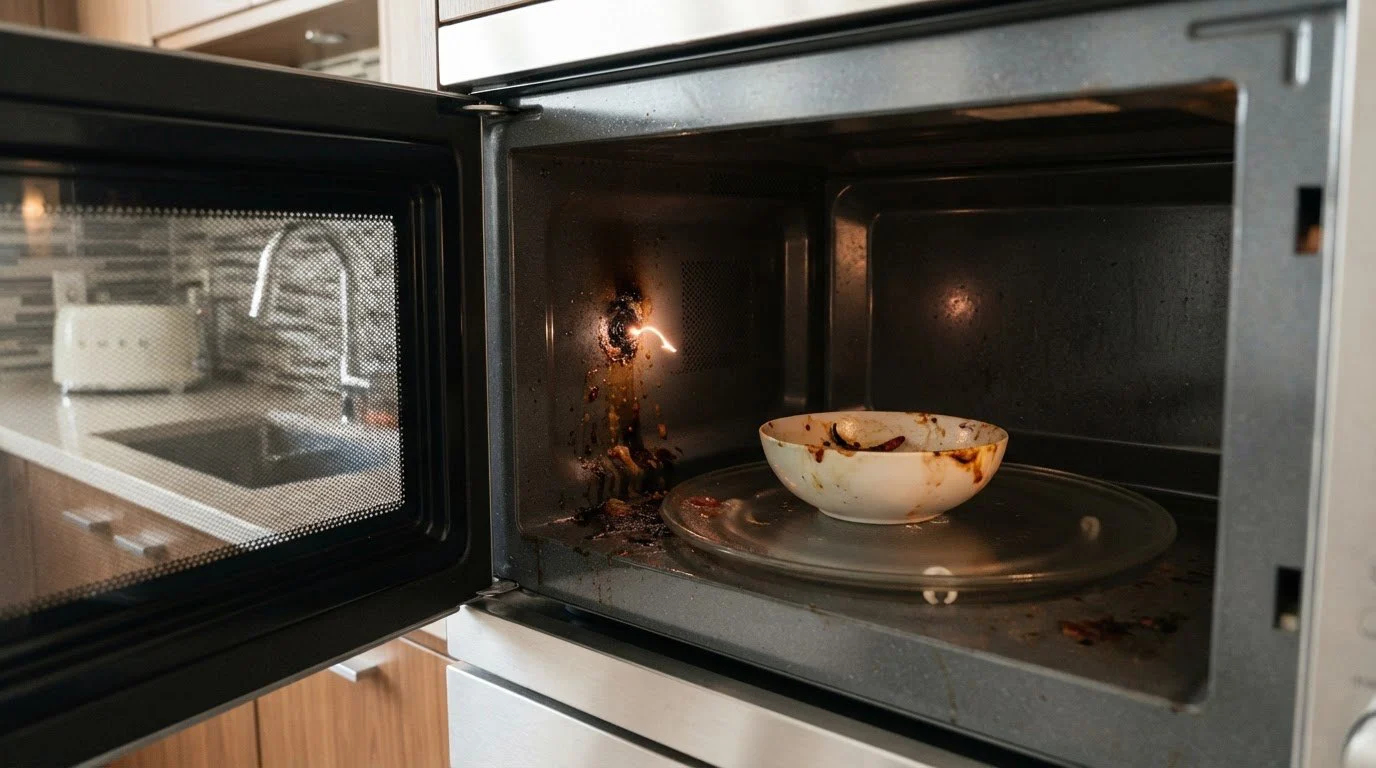
You started a cup of coffee and saw a blue flash, or heard a sharp crackle from behind the door. Maybe a small burnt spot appeared on the cavity wall. Sparking, also called arcing, happens when microwave energy jumps between two points that are too close together or concentrates on a sharp metal edge. Sometimes the cause is simply something you put in. Other times the cavity itself has changed.
Stop the cycle and open the door only after the oven has switched off. Do not keep running a microwave that sparked while empty or one that left a burnt smell. If you see flames, keep the door closed and switch the unit off at the breaker or unplug it. If you smell burning or see smoke after the unit is off, switch it off at the breaker and ventilate. An over-the-range unit is a hardwired or plug-in appliance that sits above a gas or electric range, so keep the range area clear too.
If the sparking stops when you remove the suspect item and run a small glass of water, the unit may be fine. If it sparks with nothing metal inside and only a cup of water, that points to the microwave itself.
Behind a small rectangular cover on the side wall of many cavities, the waveguide carries microwave energy from the magnetron into the cooking area. That cover is made of a thin, light-colored material and is easily damaged by grease and food. Once it burns or cracks, it arcs, and it can blister. Other suspects are paint that has flaked off the cavity wall to expose bare metal, a shelf support or rack that is touching the wall, and a door seal or latch area with burned residue.
A more serious failure sits deeper. A magnetron or high-voltage component that has worn out can produce odd noises, a burning smell and uneven heating along with, or instead of, visible flashes. None of those parts are safe to examine without training, since the capacitor can hold a dangerous charge even when the unit is unplugged.
Do not remove screws, lift the top, open the control area, or try to probe the door switches. Do not use the unit again if it sparked with only water inside. Leave any repair involving the magnetron, capacitor or transformer to a technician.
Many Bay Area kitchens use an over-the-range microwave in place of a separate hood. The Frigidaire FMOS1746BS and FMOS1846BS are both over-the-range units, with cooking grease and steam drawn up from the range underneath. That means more grease on the cavity and the vent grille, and a greater chance that dirty residue becomes a spark source. Clear the vent grille and clean the filter on a regular schedule, since a clogged vent also makes the unit run hot.
Tell us what you saw: the color of the flash, where in the cavity it appeared, whether it happened with food, water or nothing at all, and whether there was a smell or a crackle. Mention how long the unit has been in use and how often the cavity gets wiped. That description helps separate a food and dish issue from a worn cover, and it tells us whether to bring the waveguide cover and door seal for the first visit.
The cover, rack and door seal differ by model, and the correct replacement part depends on the exact number on the label. On many over-the-range units the label is inside the door frame or on a side wall of the cavity. Write it down with a photo of the burnt area if you can. You can also look at the Frigidaire microwaves guide to see how the lineup is organized.
We open the unit with the proper discharge steps, inspect the waveguide cover, cavity paint, door seal and latch switches, and test the high-voltage side only after confirming it is safe. A burned cover is a small part, but if the cavity has been burned through or the magnetron has failed, the repair may not make sense, and we say so before work starts. You receive a written estimate, and nothing is repaired without your approval. See Frigidaire microwave repair for how a visit runs.
If something metal was inside and the sparking stopped after you removed it, it is likely fine. If it sparked with only water, stop using it and have it checked.
They are usually carbonized grease around the waveguide cover, which is the small rectangle on the cavity wall. A burned cover can arc and should be replaced by a technician.
No. Tape and foil can ignite or spark. Leave the cavity alone and stop using the unit until the cover or paint has been repaired.
Gold and silver decoration is metal, and microwave energy concentrates on its edges. Use plain microwave-safe dishes instead.
Yes. Dried food, grease and sugar carbonize under heating and become conductive. Wipe the cavity and door seal regularly and let them dry completely.
Share a few details and we’ll confirm an appointment. Prefer to talk? Call us and we’ll help right away.